RAID 5 Data Recovery
Professional RAID 5 data recovery services across the United Kingdom — trusted by businesses to recover lost data from failed arrays
- Free DiagnosticsNo-obligation quote
- No recovery, no feeFor most jobs
- 7–10 Working DaysEmergency 12–72 hours
What can make a RAID 5 array fail
A RAID 5 array fails when it loses more than its parity can cover: a second disk failure, a failed rebuild, a controller fault, an accidental re-initialisation, or a firmware or power problem. RAID 5 is built to survive one failed disk through parity.
Multiple drive failures in sequence
A RAID 5 array can tolerate one failed drive. When a second disk fails before the first is rebuilt, the entire array goes offline. This is a common cause of RAID 5 data loss. You'll notice the server becomes unresponsive, and the RAID controller reports a critical or offline status. Do not attempt a rebuild — this can overwrite parity data and make recovery far more difficult.
Failed RAID rebuild
A rebuild places enormous strain on the remaining drives. If another disk develops bad sectors during this process, the rebuild will abort. The array drops into a degraded or failed state, and your files become inaccessible. This situation requires professional RAID 5 recovery to extract data without causing further damage.
RAID controller failure or corruption
The RAID controller manages striping order, parity calculations, and disk mapping. When the controller fails or its configuration becomes corrupted, the array can't assemble correctly. Swapping in a new controller without matching the original settings can destroy the array structure entirely.
Accidental reconfiguration or deletion
Someone reinitialises the array. Someone deletes a virtual disk. These human errors strip the RAID metadata from the drives. The data still exists on the physical disks, but the logical structure is gone. Our engineers can reconstruct the original RAID parameters and recover the files that are still readable.
Firmware issues or power surges
Unexpected power loss can corrupt the file system — XFS, NTFS, or Linux ext volumes sitting on top of the RAID. Firmware bugs in NAS devices from Buffalo, Synology, or QNAP can also trigger false rebuild attempts. If your NAS or server won't boot after a power event, contact us before powering the unit back on.
What to do when a RAID 5 array fails
Stop using the array, and don't start a rebuild. Anything that writes to the disks now can turn a recoverable array into lost data.
- Don't start a rebuild or swap in a new disk yet. An array already missing one disk has no redundancy left, so a rebuild can turn a second fault into data loss.
- If the array is still online but degraded, and the data matters with no current backup, copy the data off first.
- Don't re-create or re-initialise the array unless you know its original settings. Re-creating writes new metadata, and if the chunk size, disk order, layout or offset differ, the data is read from the wrong places.
- Don't run recovery software on the disks. It can overwrite the data you're trying to recover.
- Don't keep powering a failed disk on. If its heads are damaged, each attempt can damage the platters further.
To speak to someone first, call the emergency line (07511 051360).
5 Highlights on RAID 5 Data Recovery
RAID 5 data recovery is a specialised discipline that demands deep knowledge of striping, parity distribution, and array configuration.
Expert RAID 5 recovery engineers
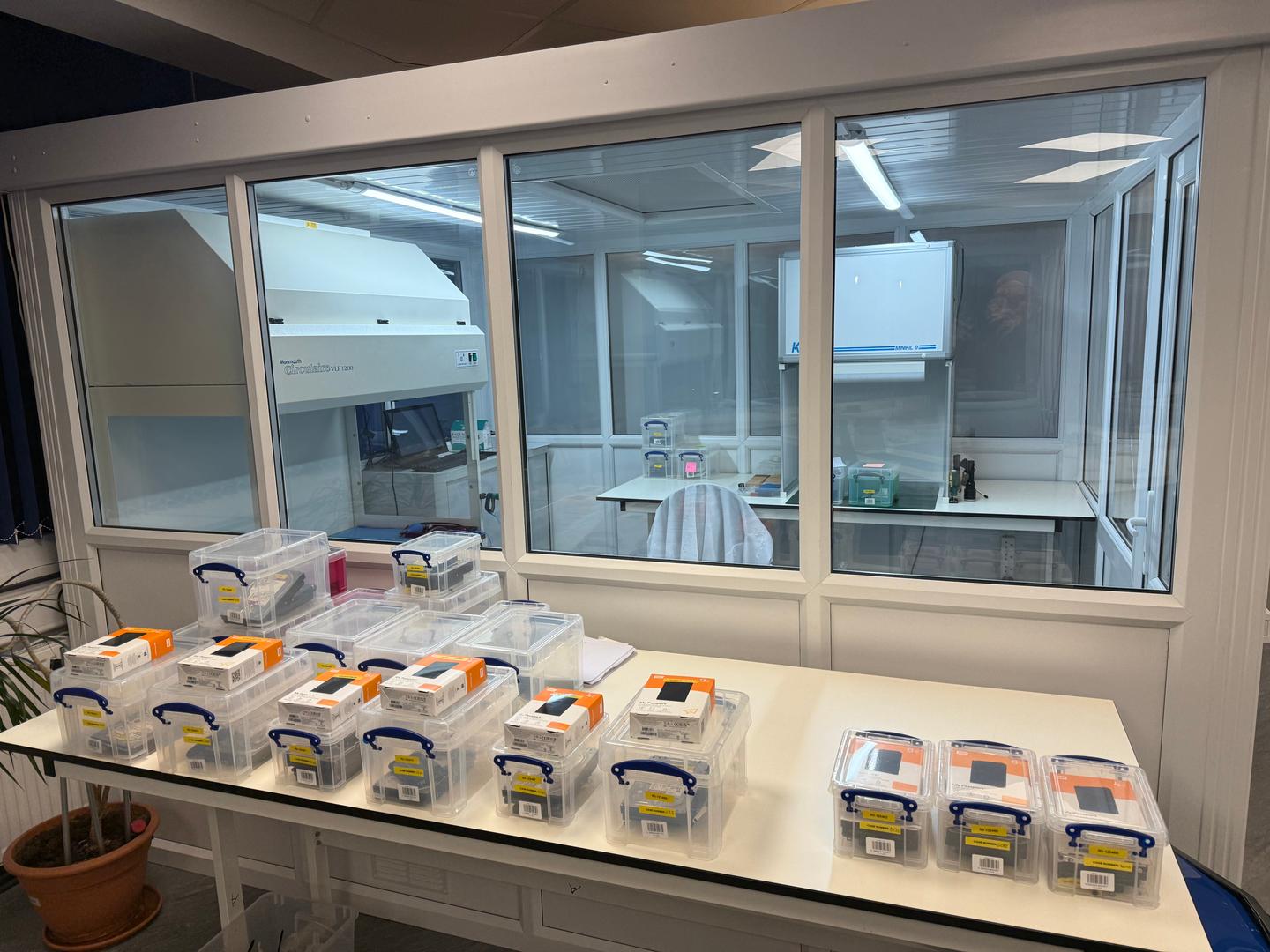
Our qualified team recovers data from degraded, failed, and collapsed RAID 5 arrays using specialist tools and our ISO Class 3 cleanroom facility at Security House in Sheffield, with additional processing at our Hitchin lab.
No recovery, no fee for most jobs
R3 Data Recovery operates a no-obligation policy: no recovery, no fee for most jobs. We provide a free evaluation and detailed file list before any work begins.
Emergency RAID 5 service available
We offer a priority emergency service for businesses facing critical data loss. We arrange free collection within 60 minutes from anywhere in the United Kingdom, with emergency turnaround in 12–72 hours depending on complexity.
Proven success rate on complex arrays
With 50,000+ successful recoveries and 96+ documented RAID cases, our team has extensive experience with multiple drive failures, controller corruption, parity errors, and failed rebuilds across Dell, NetApp, EMC, and Buffalo systems.
Secure, confidential data handling
All personal data and business information is handled under strict security protocols. Every client receives a tailored service level agreement, and all recovered data is returned via encrypted storage media.
Talk to a RAID 5 recovery engineer
If your RAID 5 array has failed, degraded, or become inaccessible, our engineers are available to review your situation and advise on next steps.
Why Choose Our RAID 5 Data Recovery
RAID 5 data recovery is a specialised discipline that demands deep knowledge of striping, parity distribution, and array configuration. R3 Data Recovery has built its reputation on precisely this expertise. Our engineers work on RAID recoveries daily, and that hands-on experience is what this work needs.
We operate from our main laboratory at Security House in Sheffield and our secondary lab in Hitchin, Hertfordshire. Our Sheffield facility contains an ISO Class 3 cleanroom and specialist tools for RAID reconstruction. With free collection from anywhere in the UK, your drives are brought directly to our secure facilities — they never leave the country.
Our approach starts with a free consultation. You call us on 0800 999 3282 or complete our online form, and we arrange free collection of your drives. We then perform a full evaluation at no cost and no obligation. You'll receive a detailed quote and a file list showing exactly what we can recover before you commit.
Customers can read what others say about us on Reviews.io. Our clients range from small businesses running a single NAS device to large enterprises with multi-disk server arrays. We treat every case with the same level of care and confidentiality.
No recovery, no fee for most jobs. When a RAID 5 array fails, you need a proven, professional recovery service — and that's what we provide.
Our RAID 5 Data Recovery Process
RAID 5 data recovery is a structured, methodical process. Every step is designed to protect the original data and give you the best chance of a complete recovery.
- 1
Free collection and intake
Call us on 0800 999 3282 or submit our online form. We'll arrange free collection of your RAID drives or NAS device from any location in the United Kingdom. Each drive is labelled, catalogued, and logged into our secure tracking system upon arrival at our lab.
- 2
Diagnostic evaluation
Our engineers examine every drive individually. We check for physical damage, bad sectors, firmware faults, and mechanical failure. Drives that need physical repair are handled in our ISO Class 3 cleanroom. This evaluation is completely free and carries no obligation.
- 3
Copying each disk
Each disk is copied sector by sector first. All recovery work is performed on these copies — never on your original drives. This preserves the source data in its found state.
- 4
Array reconstruction
Our team determines the original RAID 5 parameters: stripe size, parity rotation, disk order, and start offset. Using specialist tools and deep knowledge of RAID architecture, we reconstruct the virtual array from the copies.
- 5
Data extraction and file list
We extract the file system and generate a detailed file list. You'll receive this list along with a no-obligation quote. You review exactly what we've recovered and decide whether to proceed.
- 6
Secure data return
Once approved, we copy your recovered data to encrypted storage media and arrange secure return delivery. All source drives and working copies are handled according to strict confidentiality and data security protocols.
Examples from the lab
A Dell PowerEdge T110 II server came in with a three-drive RAID 5 array. One drive had dropped off the array a long time ago. The engineers copied the disks sector by sector, identified the RAID parameters, and left that drive out of the reconstruction. The result was a full file tree without errors. Dell PowerEdge RAID 5 case study
From R3's lab records
All four drives in a QNAP TS-410 showed as unmounted after a power outage. Every drive copied with 0 bad sectors, but the disk order had changed and the metadata was gone. The engineers worked out a usable configuration. 1.47TB came back, with subfolders intact and the root folder names lost. QNAP RAID 5 case study
From R3's lab records
A QNAP TVS with eight 8TB drives failed, and the customer thought one or two drives were to blame. Seven copied cleanly. Drive 8 had 1,671 bad sectors, which the engineers corrected and suspected had brought the system down. It was a group volume, so the copies went back into the QNAP to read it. 22.8TB came back.
From R3's lab records
Brands We Work With
RAID 5 data recovery requires familiarity with a wide range of hardware manufacturers. R3 Data Recovery has direct experience recovering data from arrays built on these trusted brands.
- DellPowerEdge servers and MD series storage arrays
- NetAppFAS and AFF enterprise storage systems
- EMCVNX, Unity, and Clariion SAN platforms
- BuffaloTeraStation and LinkStation NAS devices
- IBMSystem x servers and Storwize arrays
- SeagateIronWolf, Exos, and Barracuda enterprise drives
- Western DigitalWD Red, Ultrastar, and Sentinel series
- HP EnterpriseProLiant servers and MSA storage
- SynologyDiskStation and RackStation NAS units
- QNAPTS series and enterprise ZFS-based NAS devices
Each manufacturer uses different firmware, controller logic, and proprietary RAID implementations. Our engineers have the tools and knowledge to work with these systems. Regardless of the brand, we handle every drive and device with the same level of care — in secure ISO Class 3 cleanroom conditions — to protect your data throughout the recovery process.
How customers describe RAID 5 recovery
Selected customer perspectives relevant to degraded arrays, rebuild failures, server storage, and high-stakes RAID 5 recovery decisions.
- Rated 5 out of 5Verified
4-disk RAID5 file server, 300 miles, 98%+ recovery
“We had an issue with a failed 4 disk RAID5 array on a file server that hadn't backed up properly in a good 6 months - we attempted recovery ourselves but found a lot of files were corrupt, and some of the most recent files were missing. We contacted R3 Data Recovery at 8:51 am on the 7th Jan and had a very reasonable quote by 9:19 am - the data was collected later that afternoon and was in their hands and imaging that same day, which isn't bad considering we're a good 300 miles or 6 hours drive away. We received a zip file with some of the most important files by the 10th and had all the files on a hard drive back by first thing Monday 13th. Our drives were really badly damaged, lots of bad sectors, however, R3 Data Recovery were able to restore 98%+ of the files, and have saved us a good few thousand man-hours of work.”
Mark Robinson4-disk RAID5 file server, 300 miles, 98%+ recoveryCustomer review from Reviews.io
- Rated 5 out of 5Verified
LaCie 5Big 20TB RAID 5, insurance-covered, "huge relief"
“Quick, professional and polite. Great team. A huge relief dealing with our very stressful problem.”
NickIslington, United KingdomLaCie 5Big 20TB RAID 5, insurance-covered, "huge relief"Customer review from Reviews.io - Rated 5 out of 5Verified
WD ShareSpace RAID 5, power damage, 99% recovery
“The service I received from Andy at R3 Data Recovery was first class. Having thought I had lost the entire contents of my WD external ShareSpace the team were able to recover over 99% of all the data. I will recommend them to anyone I know that ever has a data loss/corruption issue. Hopefully I won't have the need to use them again, but if I did I wouldn't hesitate to call them. Great job, thank you”
Simon BatemanWD ShareSpace RAID 5, power damage, 99% recoveryCustomer review from Reviews.io
RAID 5 Data Recovery Questions
Common questions about recovering data from failed, degraded, and corrupted RAID 5 arrays.
What is RAID 5 data recovery?
When should I contact a RAID 5 recovery specialist?
How long does RAID 5 data recovery take?
Can you recover data from a RAID 5 with two failed drives?
Does RAID 5 recovery cost more than single drive recovery?
How do you keep my data secure during recovery?
Other RAID Recovery Services
- RAID 0 Data RecoveryRAID 0 uses the same block-level striping as RAID 5 but without parity — a single drive failure destroys the entire array. The stripe geometry and sector mapping are identical between the two configurations, so RAID 5 and RAID 0 share the same foundational reconstruction process.
- RAID 1 Data RecoveryRAID 1's two-drive mirror offers faster, lower-risk rebuilds than RAID 5's distributed parity reconstruction, making it common for boot volumes alongside RAID 5 data arrays. When both configurations share the same server or NAS chassis, a hardware failure can affect both simultaneously.
- RAID 10 Data RecoveryRAID 10 trades RAID 5's storage efficiency for lower rebuild risk and higher random I/O throughput. Database servers commonly pair RAID 10 transaction logs with RAID 5 bulk storage — a shared controller or backplane failure impacts both arrays.
Ready to Recover Your RAID 5 Array?
Contact our RAID 5 recovery specialists for a free assessment and no-obligation quote. For an emergency, call our 24/7 emergency line.
Looking for general RAID recovery? View our RAID Data Recovery service